
Fine-Tuning Gemma for Personality - Part 5: Base Models vs Instruction-Tuned
This is Part 5 of a series on fine-tuning Gemma for personality. Read Part 1 for the concept, Part 2 for the dataset, Part 3 for training, and Part 4 for the short response problem.
Same training data. Same hardware. Same 5 minutes. I tested both base (-pt) and instruction-tuned (-it) models to see if one would handle personality better. Both struggled with consistency.
Gemma models come in two flavors:
- Pre-trained (-pt): Base models trained on text continuation
- Instruction-tuned (-it): Further trained to follow conversational patterns
I ran the same Bluey dataset through both gemma-3-1b-pt and gemma-3-1b-it.
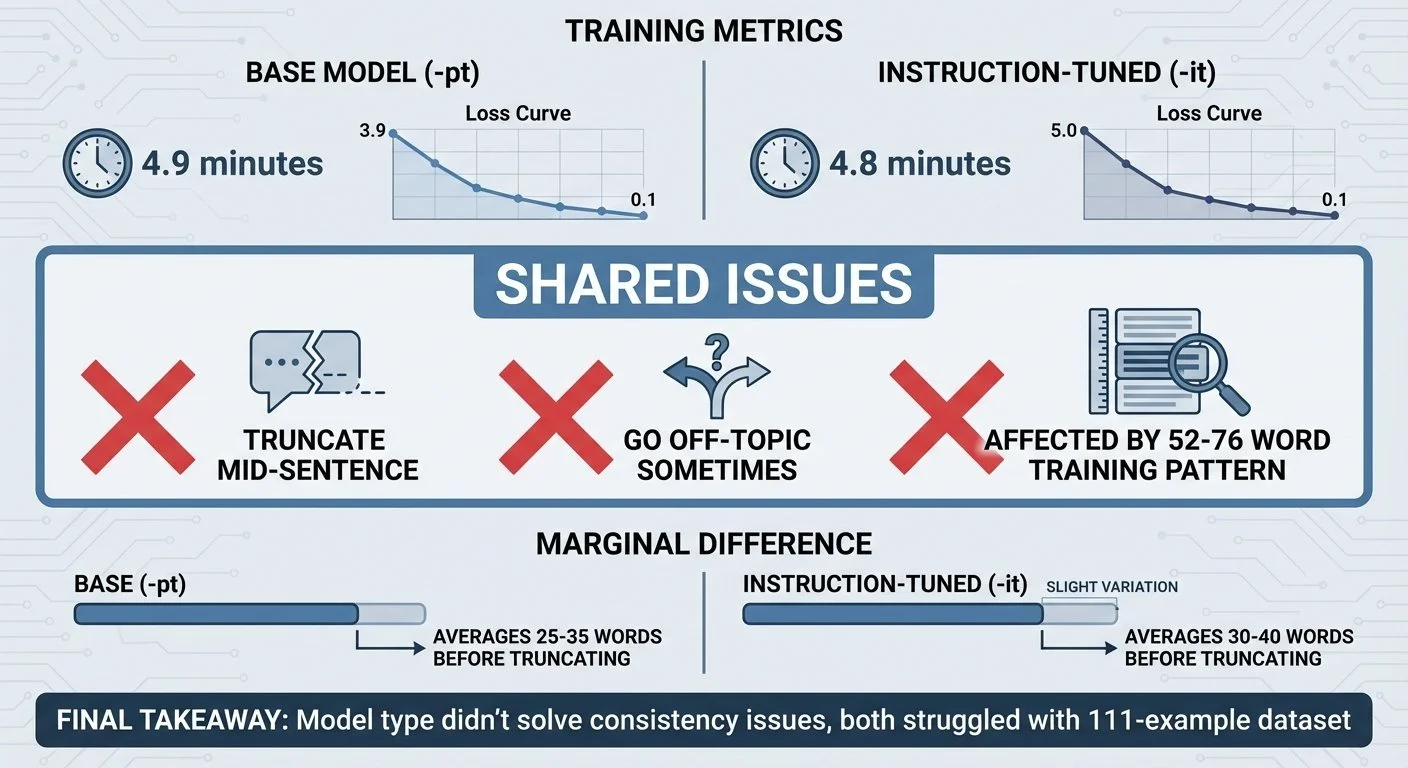
Base vs instruction-tuned model comparison showing shared issues and marginal differences]
Training time was nearly identical (4.9 vs 4.8 minutes). Both models reduced loss significantly (ending around 0.1). I tested both with the same prompts to see if model type made a difference.
What I found: Both models showed inconsistent behavior. Sometimes on-topic with Bluey's voice, sometimes off-topic but still in Bluey's voice, both truncating mid-sentence.
Example - "Can you help me with my homework?":
Base model (-pt):
"Yeah! That's fair, even though sometimes I don't understand. What kind of homework is it? Is it maths? Because Mum's really good at maths. Or maybe" (26 words, truncated)
Instruction-tuned (-it):
"Homework is actually pretty fun if you make it into a game! So I'm happy to help you with your homework. Just remember - if it gets too hard, you can take a break and play for a bit. That's" (40 words, truncated)
Both show Bluey patterns. The -it response is longer, but both cut off mid-sentence. Across four different test prompts, both models went off-topic sometimes and stayed on-topic other times.
See all test cases: pt_vs_it_comparison.txt shows all four prompts and responses. Run compare_pt_vs_it.py to reproduce these results.
The theory: instruction-tuned models are pre-trained on conversational patterns, so they should handle personality fine-tuning better with limited data.
The reality: both models struggled. Both went off-topic sometimes. Both truncated responses. Both reproduced Bluey patterns inconsistently.
The marginal difference: the -it model produced slightly longer responses before truncating (30-40 words vs 25-35 words). But "longer" doesn't mean "better" when both are cutting off mid-sentence.
With only 111 examples, neither model type solved the consistency problem. The training data limitations affected both equally.
Next: how to test personality (you can't unit test "sounds like Bluey").
Part 5 of 8 in the Fine-Tuning Gemma for Personality series.
gemma-local-finetune - View on GitHub
This post is part of my AI journey blog at Mosaic Mesh AI. Building in public, learning in public, sharing the messy middle of AI development.