
Fine-Tuning Gemma for Personality - Part 4: When Your Model Learns Too Well
This is Part 4 of a series on fine-tuning Gemma for personality. Read Part 1 for the concept, Part 2 for the dataset, and Part 3 for training on Apple Silicon.
The model reproduced Bluey's speech patterns. Then it stopped generating after 76 words. The training data's average response length may have become a constraint.
After training, I tested the model with: "Tell me about your family."
Expected: A detailed, enthusiastic response about Mum, Dad, and Bingo.
Got: Responses ranging from 12-63 words, often cutting off mid-sentence. The model hit the EOS (end-of-sequence) token early, even with max_new_tokens=400.
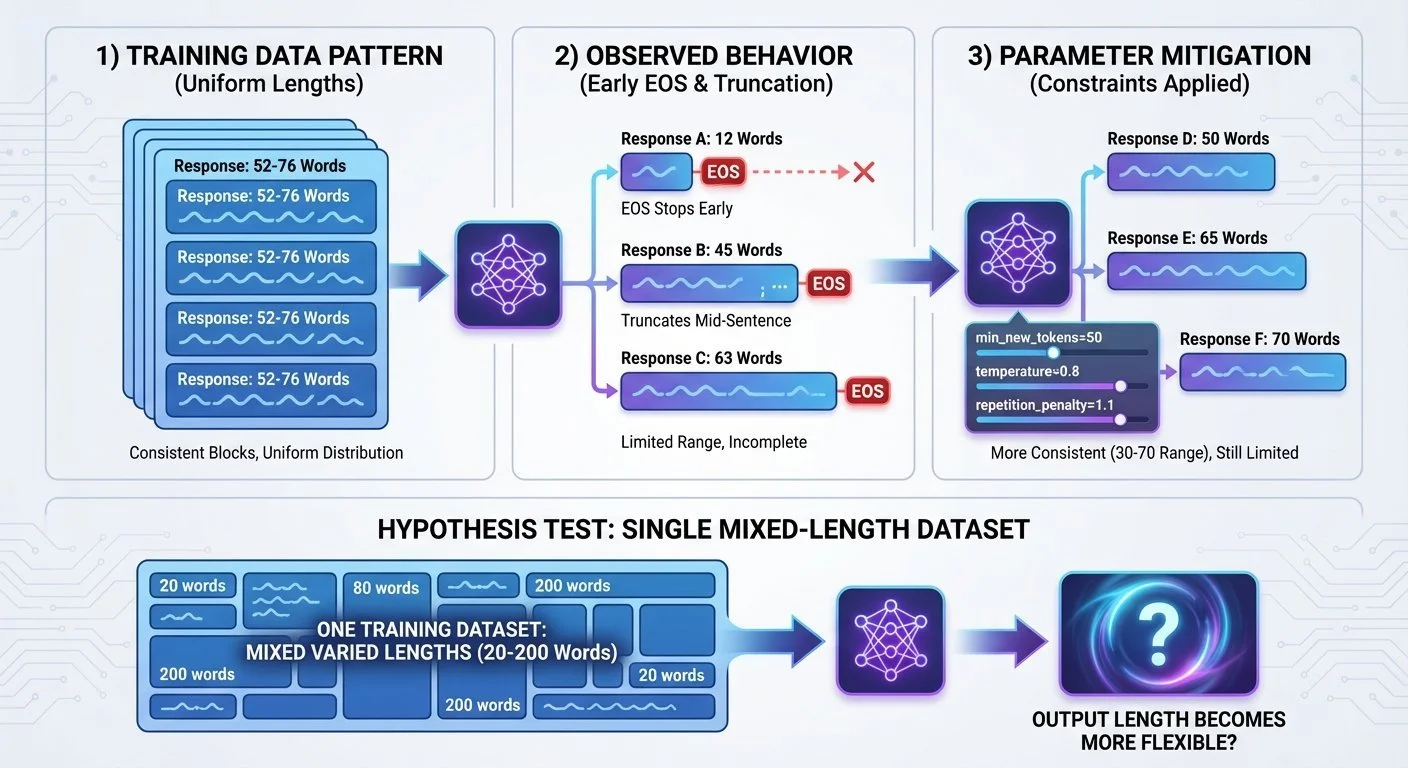
The short response problem - training data patterns, observed behavior, and parameter mitigation results
A possible cause: the training data averaged 52-76 words per response. The model may have learned that pattern as "correct response length."
One mitigation approach: generation parameter tuning (test_min_tokens_fix.py):
response = model.generate(
    prompt,
    max_new_tokens=400,
    min_new_tokens=50,      # Prevent very short responses
    temperature=0.8,         # Balanced creativity
    top_p=0.95,
    top_k=50,
    repetition_penalty=1.1,  # Reduce loops
    do_sample=True
)
min_new_tokens=50 prevents the model from stopping early. temperature=0.8 encourages variation. repetition_penalty=1.1 reduces phrase loops.
These parameters helped reduce the variability—responses became more consistent, avoiding the extremely short 12-word outputs. But most responses still stayed in the 30-70 word range rather than expanding to longer, complete thoughts.
To test this hypothesis, you'd need to fine-tune again with deliberately varied response lengths (30-200 words) in the training data and compare the results.
Overfitting is usually bad. For personality capture, it can be a useful feature. You want the model to internalize Bluey's patterns. But you don't want it to learn unintended constraints like response length.
The lesson: training data patterns may matter as much as content. If all your examples are 52-76 words, the model may learn that as "correct." Generation parameters can mitigate this but may not fully override it. One approach to test: vary response lengths deliberately in your training data from the start and compare the results.
Next: comparing base models vs instruction-tuned models for personality consistency.
Part 4 of 8 in the Fine-Tuning Gemma for Personality series.
gemma-local-finetune - View on GitHub
This post is part of my AI journey blog at Mosaic Mesh AI. Building in public, learning in public, sharing the messy middle of AI development.