
Removing Friction: Automating Nano Banana Image Workflows
Five minutes of manual work for every blog image—convert PNG to JPEG, resize, move to the right folder. While generating images for a 9-part blog series, I'd had enough. Twenty minutes of coding eliminated the friction.
My nano-banana CLI (introduced when I added model 3 support) generates images from Gemini's API. But the workflow had manual friction:
The old way (5 minutes):
- Run
nano-banana generate "prompt" --model 3 --resolution 1K - PNG saved to
output/2025-12-15/generated_v3_1K_timestamp.png - Open PNG in Preview, export as JPEG with compression
- Move JPEG to
~/Projects/blog/assets/series-name/image-name.jpg - Verify file size is reasonable for web
What I wanted (0 minutes):
- Run
nano-banana generate "prompt" --output ~/Projects/blog/assets/series-name/image-name.jpg --model 3 --resolution 1K - Done.
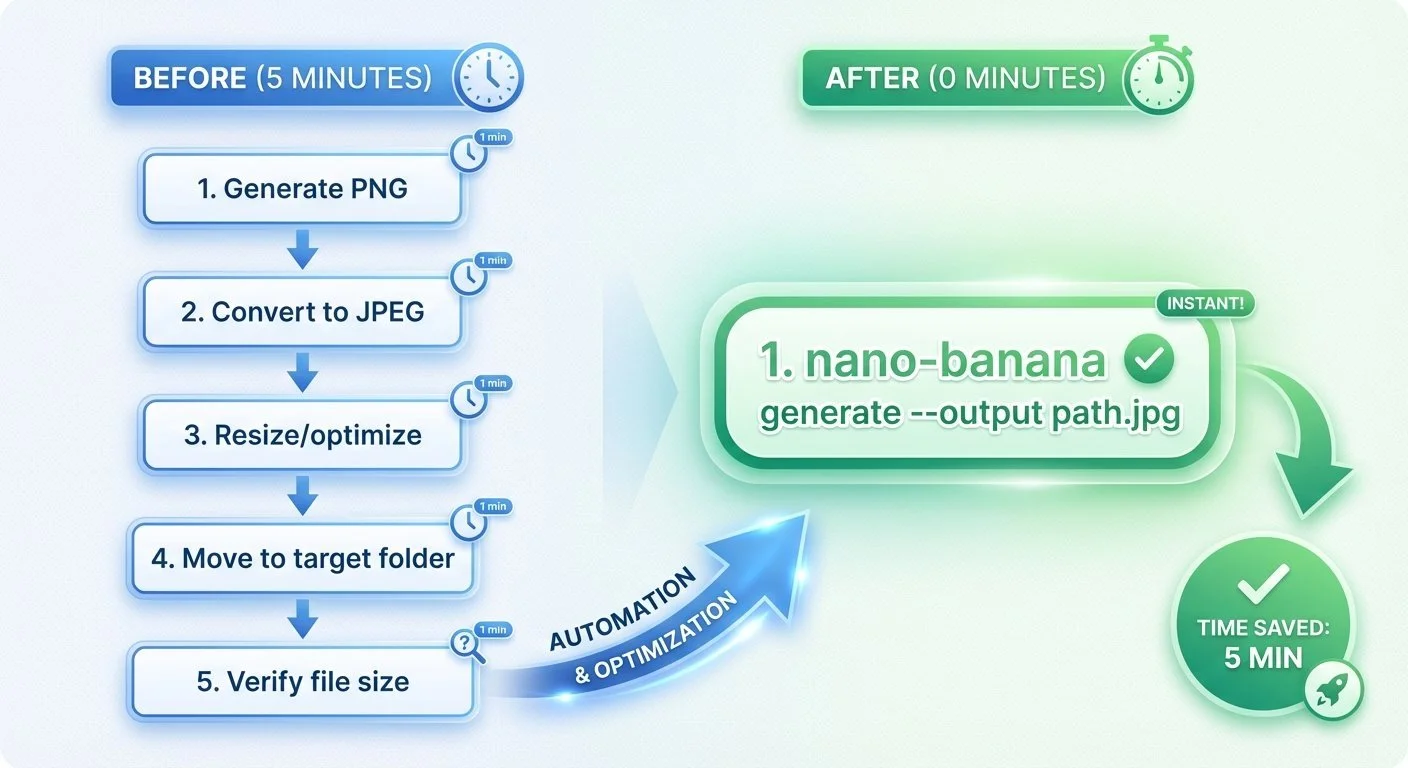
Workflow automation: Before: 5-step manual workflow. After: Single automated command.
I opened a separate Claude Code session, told it to read AUTOMATED_JPEG_OUTPUT_ENHANCEMENT.md in the nano-banana repo, and let it implement the changes. Twenty minutes later, tested and working.
The new workflow in action generating Part 7 of the Agentic Personal Trainer series:
nano-banana generate "A clean technical diagram showing LLM provider abstraction..." \
  --output ~/Projects/mosaic-mesh-ai-blog/assets/agentic-personal-trainer/agentic-personal-trainer-part-7.jpg \
  --model 3 \
  --resolution 1K

# Output:
# JPEG image saved to: .../agentic-personal-trainer-part-7.jpg (quality: 85)
# Total cost: $0.134000
One command. No manual steps. Image saved exactly where I need it, optimized for web.
Better yet: Claude Code (my AI writing partner) runs this command directly during our editing sessions. I don't even have to switch terminal windows—Claude generates the image, I verify it looks good, and we move on to the next part. The human work went from 5 minutes per image to ~10 seconds of review.
The Implementation
Three key changes (cli.py):
1. Detect output format from file extension:
output_path = Path(output).expanduser()
is_jpeg = output_path.suffix.lower() in ['.jpg', '.jpeg']
2. Add quality control:
@click.option('--quality', type=click.IntRange(1, 100), default=85,
              help='JPEG quality (1-100, default: 85)')
3. Convert and optimize on save:
if is_jpeg:
    # Convert RGBA to RGB for JPEG compatibility
    if img_data.mode in ('RGBA', 'LA'):
        rgb_image = Image.new('RGB', img_data.size, (255, 255, 255))
        rgb_image.paste(img_data, mask=img_data.split()[-1])
        img_data = rgb_image

    # Save as optimized JPEG with metadata in comment field
    img_data.save(output_path, 'JPEG', quality=quality, optimize=True)
Metadata goes in the JPEG comment field as JSON. Path expansion and parent directory creation happen automatically.
The ROI math: 20 minutes to build, 5 minutes saved per image. Break-even at 4 images. I hit break-even generating the image for this very blog post (image #4). Everything after is pure time savings.
Three images generated for the Agentic Personal Trainer series (Parts 7-9) saved 15 minutes. Every future blog post image saves another 5 minutes. Over a year of daily blogging, that's 30+ hours saved—nearly a full work week of time reclaimed.
But the real win isn't time—it's removing the decision fatigue. Before: "Do I generate an image or skip it because of the manual work?" After: "Generate the image." Friction removed, creativity unblocked.
Building tools for yourself: When you're both the builder and the user, you know exactly what hurts. No stakeholder meetings, no requirements doc, no prioritization debates. Just fix the thing that's annoying.
Incremental improvements compound: This built on the nano-banana 3 support from November. Each enhancement makes the next one easier.
Next time you catch yourself doing the same manual task for the 10th time—automate it. Twenty minutes now, hours saved later.
Project: nano-banana-experiments - View on GitHub
This post is part of my daily AI journey blog at Mosaic Mesh AI. Building in public, learning in public, sharing the messy middle of AI development.