
Building a Local Semantic Search Engine - Part 3: Indexing and Chunking
This is Part 3 of a series on building a local semantic search engine. Read Part 1 for embeddings basics and Part 2 for how semantic search works.
I pointed the search engine at itself—indexing the embeddinggemma project's own 3 files into 20 chunks. Why 20 chunks from 3 files? Because a 5,000-word README as a single embedding buries the relevant section. Chunking solves that.
The search engine's indexer walks a directory, reads text files, and generates embeddings for each. Without chunking, searching a large file tells you which file matches—but not where in that file. Paragraph 12 of 50? Good luck.
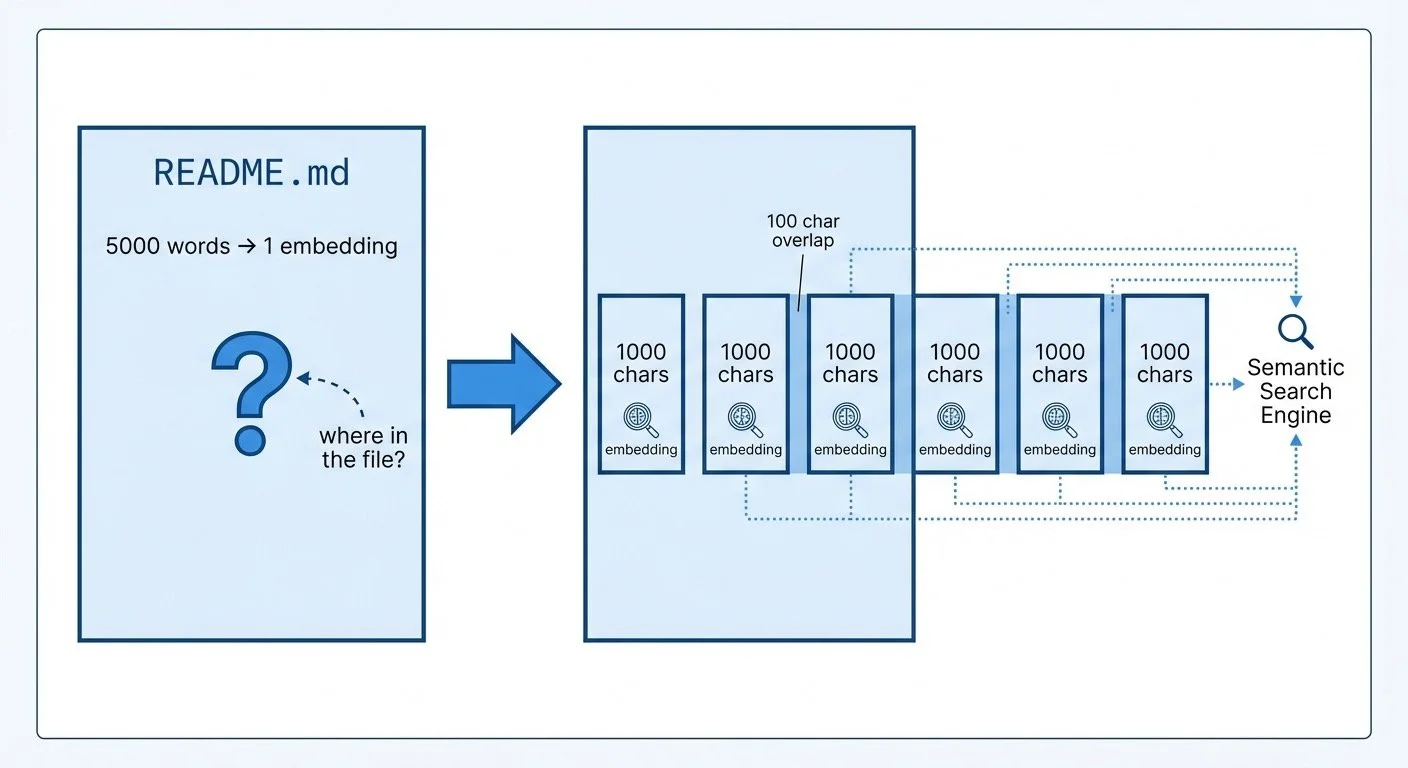
Chunking strategy: Chunking with overlap ensures context isn't lost at boundaries
The solution: split files into overlapping chunks. This is a common pattern in RAG (Retrieval-Augmented Generation) systems—you retrieve relevant chunks to give an LLM context before it answers.
I use 1,000 characters per chunk with 100 characters of overlap (semantic_search.py:51-84):
def chunk_text(text, max_chars=1000, overlap=100):
    if len(text) <= max_chars:
        return [text]

    chunks = []
    start = 0
    while start < len(text):
        end = start + max_chars
        chunk = text[start:end]

        # Try to break at sentence or newline
        if end < len(text):
            last_period = chunk.rfind('.')
            last_newline = chunk.rfind('\n')
            break_point = max(last_period, last_newline)
            if break_point > max_chars // 2:
                chunk = chunk[:break_point + 1]

        chunks.append(chunk.strip())
        start = end - overlap
    return chunks
Two details preserve context: the 100-character overlap ensures key phrases aren't split across chunk boundaries, and breaking at sentence endings (when possible) avoids embeddings for incomplete thoughts.
Note: The indexer skips common directories like venv, node_modules, and .git automatically (semantic_search.py:25-29). No one wants to search their virtual environment.
Chunk size is a tradeoff I didn't spend much time optimizing. Smaller chunks give precise matches but lose surrounding context. Larger chunks preserve context but dilute the embedding signal. I picked 1,000 characters as a reasonable default—roughly a function or a few paragraphs—and moved on. A production system would need careful tuning here.
The bigger lesson: chunking strategy matters more than I expected. It's not just about breaking up text—it's about what constitutes a "unit of meaning" worth embedding.
Next: making this fast with embedding caches. (Spoiler: the difference between "wait for it..." and instant is a single JSON file.)
Part 3 of 5 in the EmbeddingGemma series.
embeddinggemma - View on GitHub
This post is part of my daily AI journey blog at Mosaic Mesh AI. Building in public, learning in public, sharing the messy middle of AI development.