
The Bart Test - Part 7: The Social Cost I Didn't See Coming
This is Part 7 of the Bart Test series. Read Part 6 for Experiment 04 validation results and the American Ninja Warrior analogy.
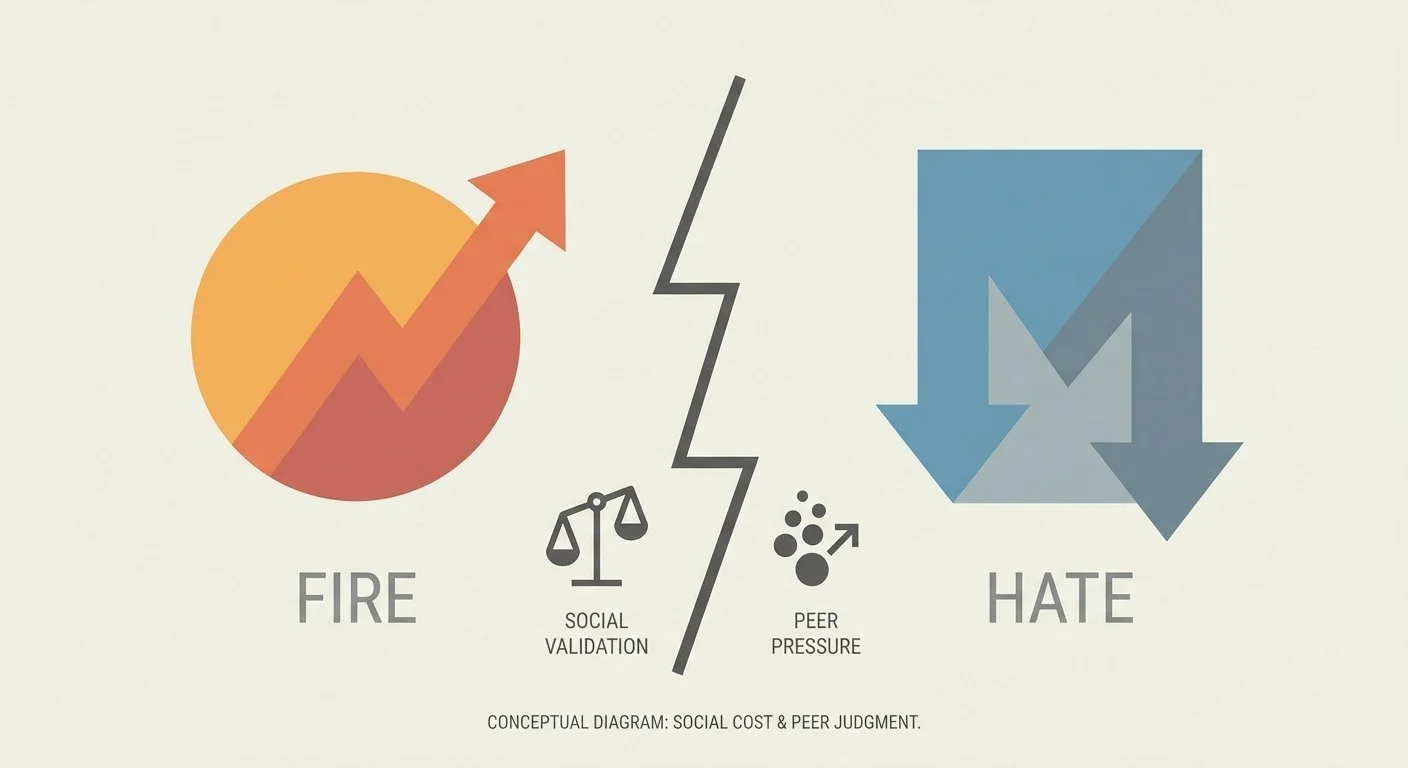
Social cost visualization showing the tension between positive and negative peer judgment
After analyzing Experiment 04's results in Part 6, I designed Experiment 05 to test a hypothesis: Would tighter constraints improve differentiation, or make the test too easy?
I ran Experiment 05. Printed the evaluation sheets. And prepared to find out.
Then I hit a wall I hadn't anticipated.
One judge was going to fill it out the next day and ask her friend to help. Then this judge told me: "[Friend] hates AI, so I reconsidered asking them."
The second judge was very clear: "Don't ask my friends to help with this!"
This wasn't about the sheets being too hard or taking too long. Experiment 04 showed that those improvements worked.
This was about something I hadn't anticipated: social cost.
For judges, participating in this experiment carries social implications:
- What will their friends think?
- Is this the "fire kid who knows about AI" or "weird kid doing adult research stuff"?
- Does their friend hate AI? (Apparently in some cases, yes.)
Asking teenagers of any generation to risk or spend social capital for an experiment is a cost I hadn't properly accounted for.
For some judges, it might be fire or novel. For others, it's a different calculation. Their peers know them. Their friends have opinions. The social dynamics are more complex.
The social cost discovery reframed the entire problem.
Before this moment, I thought the challenge was methodological: make the evaluation sheets easier, the scenarios more relatable, the process more sustainable. The paper sheets were working. The process was improving.
But now I was facing a different kind of complexity:
- Supporting judges who face social backlash
- Sustaining judge motivation
- Navigating teenage social dynamics I don't fully understand
- Building relationships with parents and teens I don't know
I could probably solve the logistics:
- Pay judges ($5-10 per session is reasonable)
- Recruit teens who think AI is fire (they exist but they might bias the results)
- Run quarterly sessions with rotating panels
But sitting on the edge of that investment—time, money, relationships—I found myself asking a different question than I'd asked before.
Not "Can I make this work?" but "Should I?"
The methodology was working. The hypothesis from Part 6 was ready to test. But was testing it worth navigating all this complexity?
I needed to ask a harder question: What value does this actually create?
If Model A is more "culturally fluent" than Model B according to teen judges... so what?
Would anyone make different decisions based on these results?
Is this revealing something about how LLMs work, or just entertaining?
I don't have a clear answer yet. And that uncertainty led me to a harder question: when does an interesting experiment become a useful tool? I'll explore that in depth in part 8.
Part 7 of 9 in the Bart Test series.
bart-test - View on GitHub
Code References
- Experiment 05 - Frontier - Refined prompts for GPT, Claude
- Experiment 05 - Llama - Local model
- Experiment 05 - Qwen - Thinking model
- Experiment 05 - OLMo - Reasoning model
- Experiment 05 Results - All outputs (never validated)
- HANDOFF.md - Full project status
This post is part of my AI journey blog at Mosaic Mesh AI. Building in public, learning in public, sharing the messy middle of AI development.